How Does a Rocker Switch Improve Power Control Across Industrial and Consumer Applications?
Rocker switches serve as one of the most widely used electromechanical switching solutions across industrial equipment, automotive systems, home appliances, lighting controls, marine panels, and numerous consumer electronics. Defined by a see-saw style actuator that rocks back and forth to open or close a circuit, this switch type is valued for its intuitive operation, structural stability, repeatable tactile response, and compatibility with both AC and DC loads.
Technical Specifications Overview
The following table summarizes common engineering parameters for high-performance rocker switches used in industrial and commercial equipment:
| Parameter Category | Typical Specification Range | Description |
|---|---|---|
| Electrical Rating | 6A–30A @ 125–250VAC / 12–24VDC | Defines maximum safe current and voltage handling capacity under continuous operation. |
| Contact Resistance | ≤ 50 mΩ (initial) | Ensures stable conductivity and minimal power loss across switching cycles. |
| Insulation Resistance | ≥ 100 MΩ @ 500VDC | Prevents leakage and maintains circuit safety in moisture-prone environments. |
| Dielectric Strength | 1500–3000VAC / 1 min | Withstands high transient voltages and prevents arc-induced damage. |
| Mechanical Life | 30,000–200,000 cycles | Indicates expected switch durability under repeated actuation. |
| Electrical Life | 10,000–100,000 cycles | Reflects performance longevity under actual load. |
| Operating Temperature | –25°C to +85°C or higher | Supports diverse industrial and automotive applications. |
| Actuator Types | Standard, raised, curved, sealed, lighted | Designed for ergonomic, visual, and environmental considerations. |
| Mounting Style | Snap-in panel mount, screw mount | Enables secure installation across enclosures and control panels. |
| Ingress Protection (optional) | IP54, IP65, IP67 | Provides water and dust resistance for marine and outdoor applications. |
| Certifications | UL, CE, RoHS, TUV | Ensures compliance with global safety and environmental standards. |
Market Role, Structural Design, and Performance Mechanics
A rocker switch operates through a pivoting actuator that rocks between stable positions—typically ON/OFF or multiple functional states such as momentary, maintained, SPST, SPDT, DPST, or DPDT configurations. The design allows the user to visually and physically sense switch status, reducing operational uncertainty in high-risk or low-visibility environments. Actuation force, travel distance, and tactile feedback are engineered to balance ergonomic comfort with reliable circuit engagement.
Internal construction includes copper alloy or silver alloy contacts for improved conductivity and arc resistance. Housing materials often employ flame-retardant nylon or reinforced thermoplastics selected for heat stability, chemical resistance, and mechanical endurance. Sealed variants incorporate rubber membranes and O-rings to minimize fluid ingress, a crucial feature for automotive dashboards, marine consoles, and power tools exposed to dust or moisture.
Load characteristics remain central to performance. Inductive loads, especially motors and transformers, require enhanced arc suppression mechanisms. High-current designs may integrate wider contact spacing, arc chambers, or specialized plating to support stable switching under surge conditions. In DC circuits, where arcs persist longer, switch geometry and materials must be engineered more precisely to prevent contact erosion.
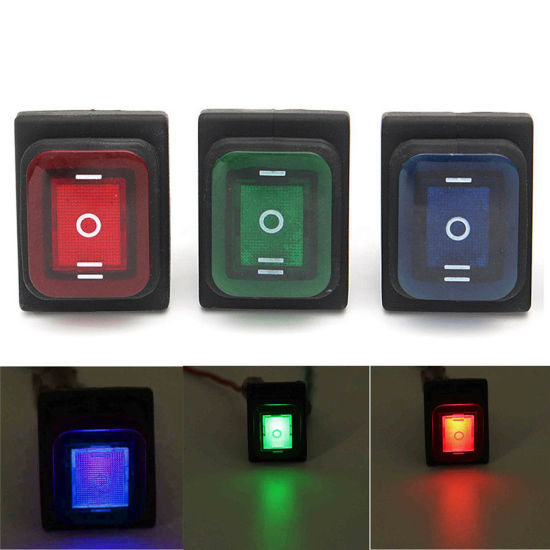
Backlit rocker switches incorporate LEDs or neon lamps, enhancing night-time visibility and providing instant operational cues. LED options deliver long service life and low power draw, supporting energy-efficient panel designs in automotive and industrial use cases.
Across global markets, rocker switches remain valued for their simplicity, cost efficiency, safety, and compatibility with a broad range of devices. Their compact footprint and scalability enable integration from small appliances to heavy-duty machinery.
Application Expansion, Safety Engineering, and Environmental Durability
Rocker switches maintain widespread adoption due to their ability to deliver controlled switching under demanding operating conditions. In industrial automation systems, they function as primary power controls, emergency shutoff mechanisms, or auxiliary circuit selectors. Their clearly defined ON/OFF positioning minimizes unintended activation and supports compliance with safety protocols.
In vehicle interiors, rocker switches dominate dashboard and steering column assemblies because of their robust feel, vibration resistance, and visual clarity. Marine-grade variants extend functionality by offering UV-resistant housings, anti-corrosive contacts, and IP67 sealing. These attributes ensure consistent performance despite exposure to saltwater, humidity, and fluctuating temperatures.
Thermal and overload protection is a growing focus. Some rocker switches integrate miniature circuit protection elements or are paired with external fuses. Engineering teams increasingly evaluate derating curves, heat dissipation behavior, and enclosure ventilation when selecting switch models for continuous-load environments.
Environmental compliance remains another priority. RoHS and REACH regulations influence material choices to reduce hazardous substances. Flame-retardant classifications such as UL94-V0 safeguard against ignition risks, particularly in appliances, HVAC systems, and power distribution modules.
As smart technologies advance, rocker switches continue to coexist with touch panels and wireless controls. Their mechanical reliability and tangible feedback provide assurance unmatched by digital interfaces alone. Hybrid designs are emerging that integrate electronic signaling or sensor-based features while preserving the traditional rocking actuator.
How-Driven Exploration of Engineering Decisions and Market Trends
How does a rocker switch maintain electrical stability across high-load conditions?
A well-engineered rocker switch leverages optimized contact geometry, arc-resistant materials, high-temperature housing, and precise mechanical tolerances to ensure stable circuit engagement. Under heavy load, the switch must resist welding, carbon buildup, and heat deformation. Advanced models employ silver alloy contacts for enhanced conductivity and arc mitigation. For inductive loads, designers incorporate spacing strategies and spring mechanisms that reduce contact bounce, thereby minimizing arc duration.
How does a rocker switch support the shift toward sealed and ruggedized solutions?
The rise of outdoor systems, marine equipment, mobile machinery, and industrial sites has accelerated demand for sealed rocker switches. This trend supports IP-rated enclosures, chemical resistance, and dust protection. Sealed designs integrate gaskets, membranes, and reinforced joint structures without compromising actuation feel. Improved sealing also extends electrical life by reducing contamination on contact surfaces, a critical factor in environments where fine particulates or moisture threaten switch integrity.
How do manufacturers ensure alignment with global market safety requirements?
Standardization is achieved through rigorous testing according to UL, IEC, TUV, and CE frameworks. Tests include dielectric strength, terminal pull, mechanical endurance, humidity exposure, flammability stability, and load-specific cycle performance. The compliance process enhances reliability and reassures engineers that each switch model can withstand real-world stress factors. With increasing globalized distribution chains, adherence to multi-region certification has become essential.
How will future precision-machined housings and LED-integrated designs influence market adoption?
Next-generation developments point toward enhanced tactile response mechanisms, smoother actuator movement, and ultra-efficient LEDs embedded in compact housings. These features improve visibility, ergonomics, and energy efficiency while aligning with evolving product aesthetics. Manufacturers are trending toward customizable illumination colors, laser-etched labels, and modular structures that integrate seamlessly with modern equipment design languages. As industries invest in energy-conserving systems, low-power LED illumination and long-life components will drive adoption.
Comprehensive FAQs, Procurement Considerations, and Brand Integration
FAQ 1: How to choose the right rocker switch for industrial or commercial applications?
Selecting the correct rocker switch begins with determining electrical load requirements, including voltage type, maximum current, and load category (resistive or inductive). Engineers must also account for operating environment factors such as moisture, dust, vibration, temperature range, and chemical exposure. Mechanical and electrical life ratings should align with expected usage frequency. For visibility-critical environments, illuminated rocker switches may be necessary. Certifications like UL or CE help validate compliance and ensure operational safety. Panel cutout size, terminal configuration, and mounting method should match the equipment’s enclosure design. These considerations collectively ensure optimal fit, durability, and safety.
FAQ 2: How to troubleshoot a malfunctioning rocker switch effectively?
Inspection begins with confirming whether power is reaching the switch by testing voltage at the terminals. If illumination is present but the connected device fails, load wiring or downstream components may be compromised. For non-illuminated switches, a continuity test helps determine whether internal contacts have worn out or carbonized. Mechanical resistance, unusual heat, or loose mounting points may indicate physical wear. Environmental contamination such as dust, moisture, or corrosion can interfere with contact surfaces, particularly in unsealed switches. Proper troubleshooting also includes evaluating the switch against its rated load; overloading may shorten service life or cause contact welding, necessitating replacement with a higher-rated model.
Procurement professionals increasingly prioritize long-term reliability, customization options, and supply chain stability. Consistent quality across production batches remains essential, particularly for OEM manufacturing. Rocker switches with standardized panel dimensions and universal terminal designs help streamline assembly processes and reduce integration complexity. Additionally, backlight color customization, actuator printing, and housing materials tailored to niche applications are becoming differentiators in competitive markets.
As global demand shifts toward durable, aesthetically refined, and environmentally resilient components, rocker switches continue to evolve while remaining indispensable across countless industries. Manufacturers capable of delivering high-precision engineering, consistent quality assurance, and responsive customization support are positioned to lead in this field.
The advanced rocker switch solutions offered under the CMZG® brand exemplify these performance standards. For technical inquiries, OEM customization requests, or bulk procurement needs, contact us to obtain comprehensive support and product guidance.